
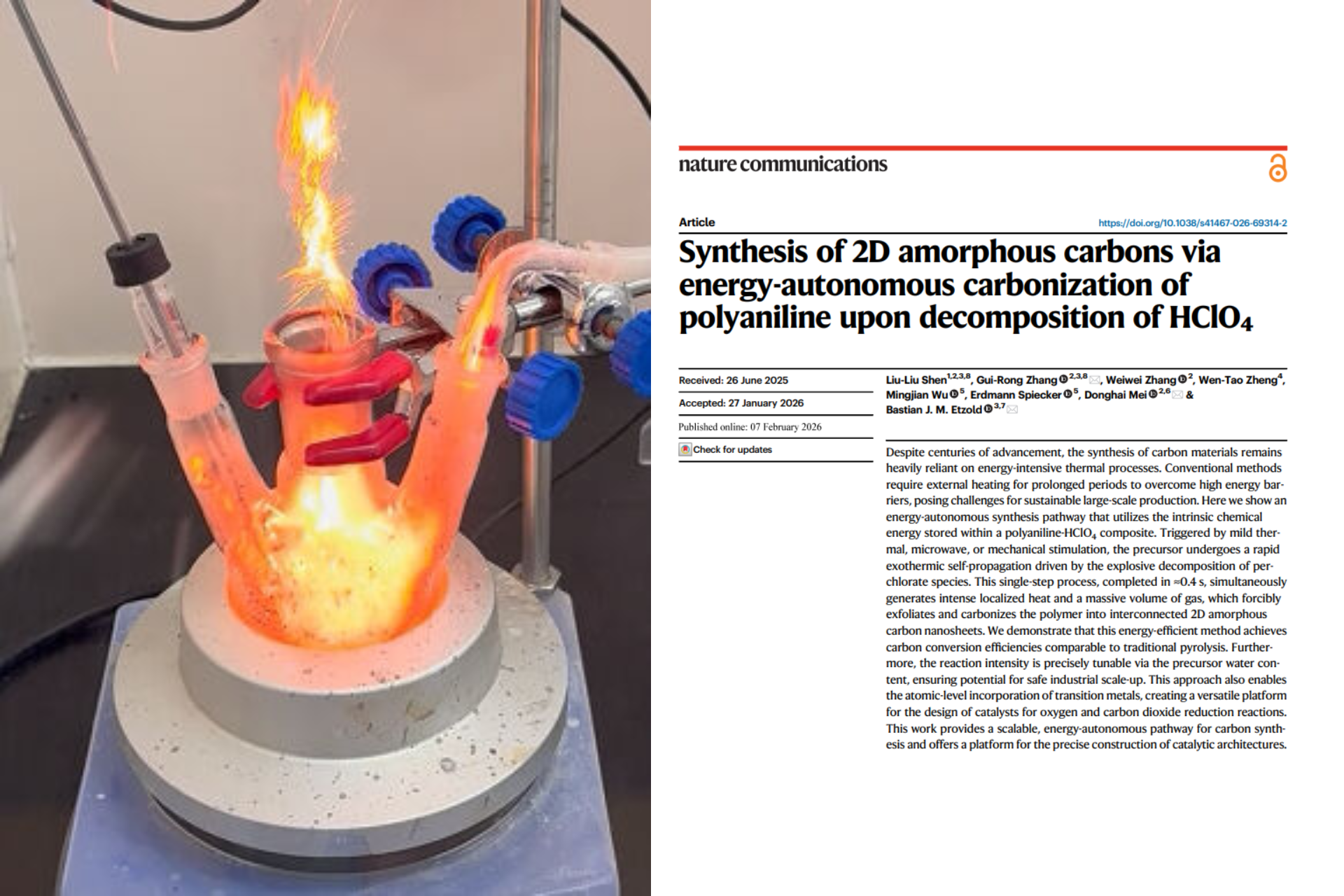
An international team, including researchers from the CBI, reports a novel synthesis route to carbon materials in the prestigious journal Nature Communications.
Carbon materials play a central role in the development of efficient and sustainable energy systems due to their high surface area combined with good electrical and thermal conductivity. Traditional synthesis routes for carbon materials typically rely on energy-intensive, time-consuming high-temperature pyrolysis processes that require external heat over several hours to convert precursors into carbon. In a sense, this is comparable to a forgotten pizza in the oven that slowly carbonizes after prolonged heating.
An international team of scientists, in collaboration with the Chair of Power-to-X Technologies, recently reported in Nature Communications a novel synthesis route for carbon materials consisting of only one or a few atomic layers and exhibiting exceptionally high surface areas. Unlike well-known graphene, these carbons are highly disordered and form a three-dimensionally interconnected network.
The research on this new synthesis approach originated from an unexpected observation:
A polyaniline-HClO₄ mixture can undergo rapid thermal decomposition when subjected to a mild trigger (e.g., slight heating, microwave irradiation or mechanical stimulation). Within a very short time, the mixture releases its stored chemical energy. Accompanied by intense gas evolution, extremely high temperatures during a short period of time, and rapid cooling, the polymer is carbonized, forming a unique carbon material. The process is more reminiscent of popcorn popping, where the structure forms within seconds through spontaneous gas release.
The researchers further demonstrated that catalytic metals can be incorporated directly into the initial mixture, yielding highly active single-atom catalysts in a one-step synthesis. This material platform is of significant interest for a wide range of sustainable electrochemical technologies, including fuel cell cathodes and electrochemical carbon dioxide reduction.