
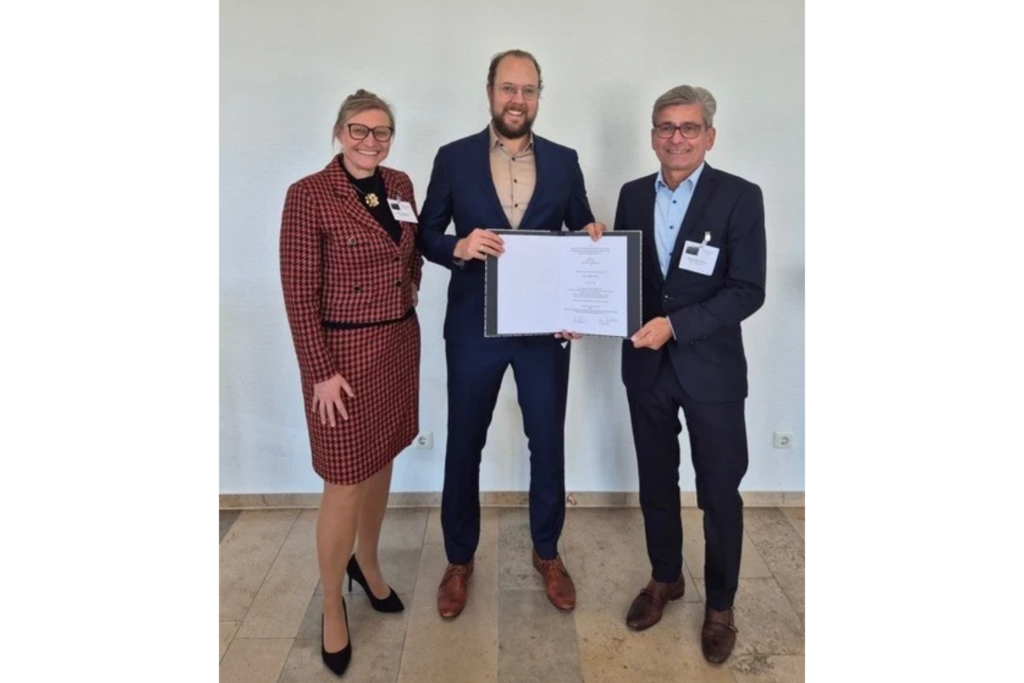
Dr. Patrick Schühle, research group leader at the Institute of Chemical Reaction Engineering (CRT), has been awarded the Carl Zerbe Prize by the Deutsche Wissenschaftliche Gesellschaft für nachhaltige Energieträger, Mobilität und Kohlenstoffkreläufe e.V. (DGMK e.V.). The award recognises his outstanding scientific contributions in the fields of catalysis, chemical reaction engineering, and sustainable carbon carriers and hydrogen technologies. Worth €5,000, the prize was presented on 8 October 2026 at the DGMK/ÖGEW/SCI Conference in Essen.
From Catalysis to Reactors to Processes: Research for the Transformation of the Carbon Economy
In his laudatory speech, Tilman Bechthold, Chair of the DGMK Division on Carbon Carrier Conversion, highlighted the particular strength of Dr. Schühle’s research approach, which combines fundamental research into catalysis with the practical application of research findings in reactor and process engineering. In his response, Schühle highlighted the potential of a circular carbon and hydrogen economy to transform the carbon economy. Through his research, he aims to help advance the transition to a climate-neutral industry.
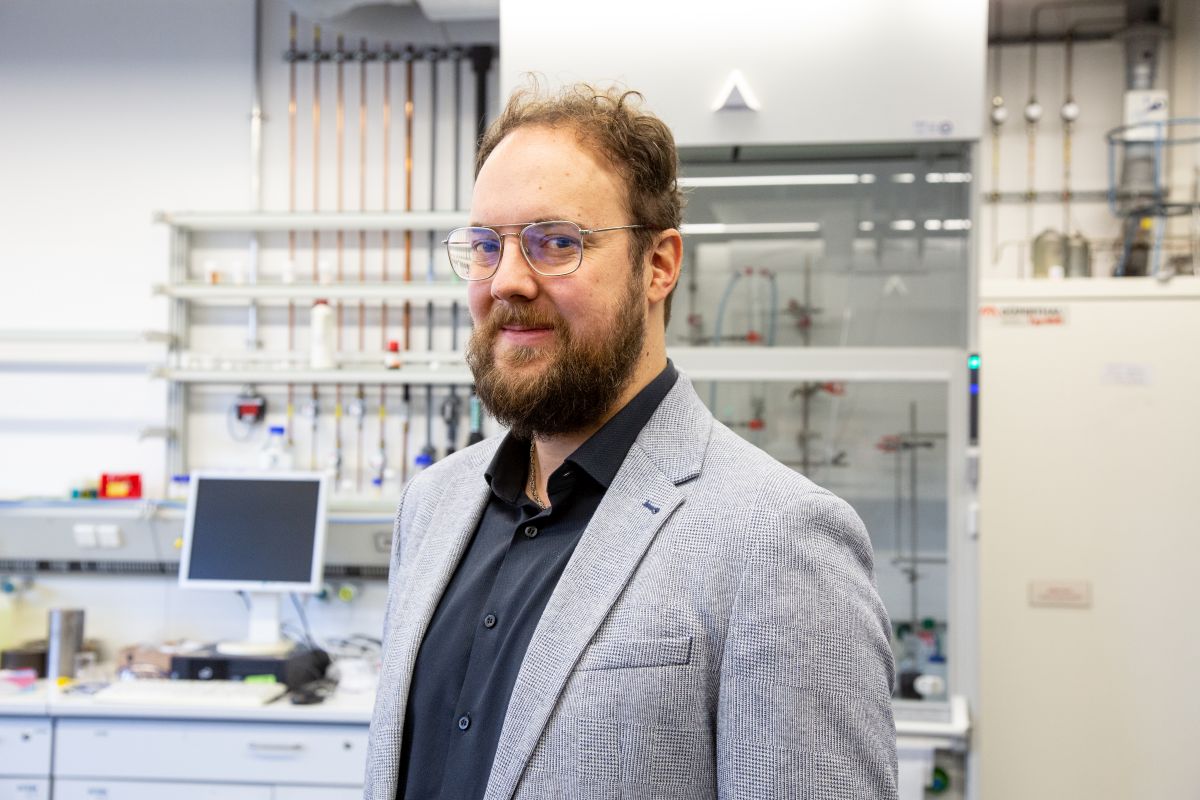
“Sustainable energy carriers and chemicals are important building blocks in the transition to a climate-neutral industry. Through my research, I aim to contribute to this effort—together with partners from academia and industry. I am delighted that this work has been recognised with the Carl-Zerbe Prize, and I would like to thank everyone who has accompanied and supported me along the way.”Dr. Patrick Schühle
Schühle earned his Ph.D. with honours in 2021 for his work on CO₂ hydrogenation to methanol at the CRT, where he has headed the research group “Catalytic Systems for Chemical Energy Storage” since 2021.
Since 2024, he has led the junior research group FAIR-H₂, funded by the German Federal Ministry of Research, Technology and Space (BMFTR). The group aims to produce high-purity hydrogen from waste biomass via aqueous formic acid as an intermediate product. The hydrogen stored in formic acid can be released and used as required with the help of the catalysts developed in the project. Another part of the project involves the construction of a technical demonstration plant to test hydrogen production from waste biomass under real-world conditions.
In addition, Schühle serves as department head at the Institute for a sustainable Hydrogen Economy (IHE) at Forschungszentrum Jülich. Since 2020, Schühle has published more than 30 papers in renowned scientific journals, serving as first or corresponding author on 19 of them.
The Carl-Zerbe Prize: A Long-Standing Tradition
The Carl Zerbe Prize was established in 1973 by the Deutsche Gesellschaft für Mineralölwissenschaft und Kohlechemie (now DGMK e. V.) in honour of the German chemist Carl Zerbe, with the aim of supporting early-career researchers. Since 1989, it has been awarded as the DGMK early-career researcher award with the additional designation “Carl Zerbe Prize”.
Past recipients of the Carl-Zerbe Prize include include Prof. Elias Klemm (1999), Prof. Peter Wasserscheid, Chair of Chemical Reaction Engineering (CRT) (2000), and Prof. Moritz Wolf (2023). Klemm completed both his doctorate and habilitation at the former Chair of Technical Chemistry I, now CRT. Wolf worked as a postdoctoral researcher at the CRT from 2018 to 2020.
The Carl Zerbe Prize honours both the excellence of Schühle’s research and its important contribution to the transition towards a climate-neutral industry.