
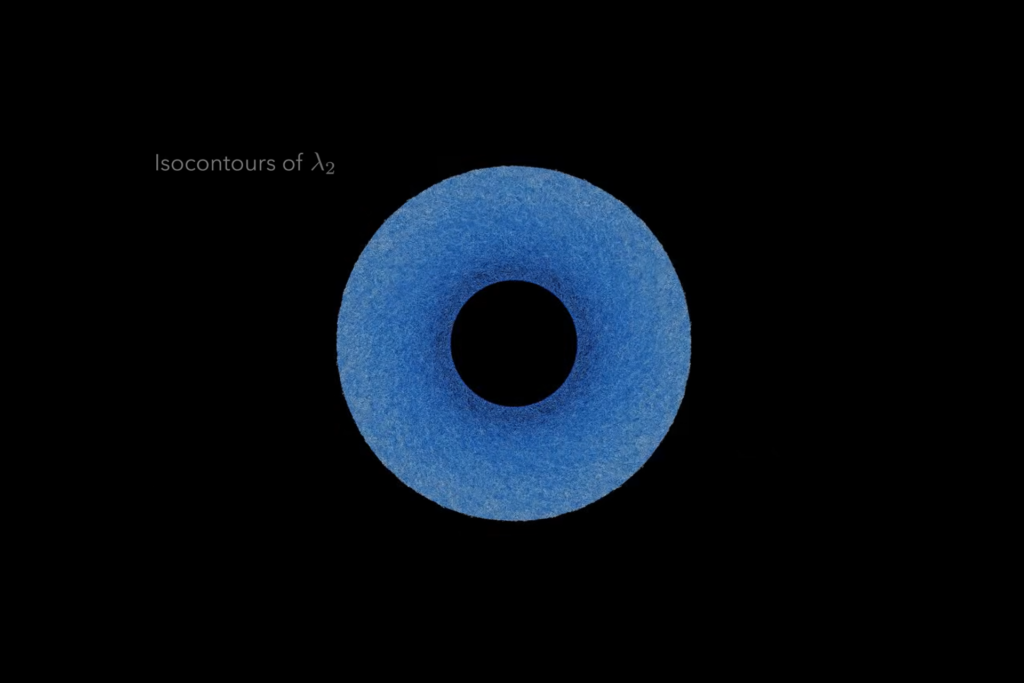
The Institute of Fluid Mechanics (LSTM), led by Prof. Philipp Schlatter, has carried out the most detailed direct numerical simulation (DNS) to date of the turbulent boundary layer above a rotating disk. Partners from KTH Royal Institute of Technology (Dr. Nicholas Morse, Dr. Niclas Jansson, Prof. P. Henrik Alfredsson, Prof. Mihai Mihaescu), OsloMet – Oslo Metropolitan University (Prof. Ramis Örlü), Forschungszentrum Jülich (Dr. Mathis Bode) and Lancaster University (Prof. Rebecca Lingwood) contributed to the work. The results advance the fundamental understanding of turbulent flows and provide reference data for developing turbulence models. In the long term, such models can improve the design of engines and turbomachinery and help reduce frictional drag on surfaces exposed to flow and increase stability against separation.
Resolving all relevant scales
The flow above a rotating disk is a classical model problem for rotating three-dimensional turbulent boundary layers, which occur in many engineering applications. For the computations, the team used JUPITER, the European exascale supercomputer, together with Neko (https://neko.cfd), a GPU-accelerated spectral-element code developed at KTH. With 18 billion grid points, the simulation resolves all relevant scales of turbulence, from the large-scale structures down to the smallest eddies. For the first time, it also captures how heat is transported from the disk surface into the flow.
Differences between heat and momentum transport
The data show that heat and momentum are transported differently in this boundary layer. Common modelling assumptions that treat the two as similar therefore describe this flow inadequately. The simulation data provide a basis for testing such assumptions and for improving turbulence models in a targeted way.
Outlook: experiments in Erlangen
Experiments are planned to complement the simulations. They are made possible by a Friedrich Wilhelm Bessel Research Award from the Alexander von Humboldt Foundation to Prof. Ramis Örlü. He will bring an experimental facility currently located at KTH to Erlangen. Hosted by Prof. Philipp Schlatter at LSTM, he will carry out measurements there next year. The experiments will serve to validate the simulations, creating a joint database of high-resolution simulations and measurements.
See a video of the simulation here: Turbulence on a turntable: Extreme-scale DNS of the rotating-disk turbulent boundary layer.
Read the conference paper about the simulation for the here:: 14th International Symposium on Turbulence and Shear Flow Phenomena.